The dream of a 4-day workweek has been whispered in offices and debated in boardrooms for years. But what if that dream is closer than we think, and powered by something truly revolutionary?
Imagine this: more time for hobbies, family, travel, or simply recharging your batteries, all while maintaining—or even boosting—productivity. Sounds too good to be true? Not anymore. The rise of Artificial Intelligence (AI) is rapidly changing the landscape of work, making the once-mythical 4-day workweek a very real possibility.
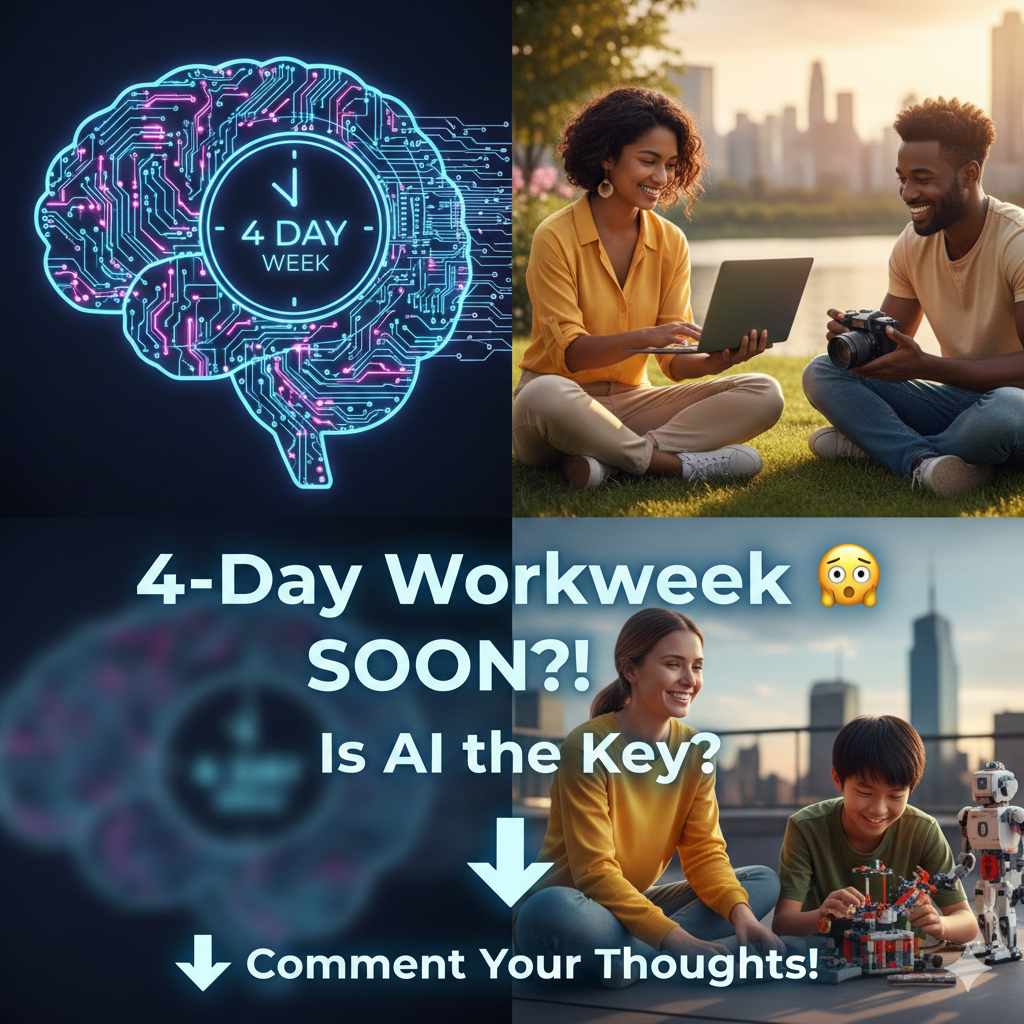
The Productivity Puzzle: How AI Fits In
For decades, the standard 5-day workweek has been the bedrock of most economies. The biggest hurdle to a shorter week has always been the fear of decreased output. But here’s where AI steps in as a game-changer.
AI’s superpowers include:
- Automation of Repetitive Tasks: AI can handle everything from data entry and scheduling to report generation, freeing up human employees for more complex, creative, and strategic work.
- Enhanced Efficiency: AI-powered tools can analyze vast amounts of data to identify bottlenecks, optimize workflows, and suggest improvements that dramatically increase overall efficiency.
- Personalized Assistance: From smart virtual assistants to AI-driven project management tools, these innovations are making individual tasks faster and more streamlined.
Think about it: if AI can take on 20-30% of your current workload, couldn’t that time be recaptured and redistributed, making a 4-day week feasible without sacrificing results?
Early Adopters & Promising Results
We’re already seeing companies experiment with the 4-day workweek, often with staggering success. These early trials frequently report:
- Increased Employee Satisfaction: Happier employees are more engaged and less prone to burnout.
- Reduced Absenteeism: With more personal time, employees are less likely to call in sick.
- Improved Recruitment & Retention: A shorter workweek is a massive perk that attracts top talent and keeps them around.
- Surprising Productivity Gains: Many companies find that focused, well-rested employees actually achieve more in less time.
Now, imagine coupling these benefits with the exponential efficiency gains offered by advanced AI. It’s not just a possibility; it feels like an inevitability.
The Road Ahead: Challenges and Opportunities
Of course, the transition won’t be without its challenges. Industries, roles, and company cultures will all need to adapt. Questions around fair wages, skill development for an AI-powered future, and ensuring equitable access to these benefits will need to be addressed.
But the opportunity is immense. A future where work is more focused, productive, and less draining for individuals could lead to a healthier, happier, and more innovative society.
Your Turn!
What are your thoughts on a 4-day workweek powered by AI? Is it a utopian dream or our imminent reality? How do you see AI transforming your own workweek?
The “AI Dividend”: Reclaiming Our Most Valuable Asset
Beyond just crunching numbers and organizing emails, the real magic of AI lies in its ability to solve the “Cognitive Load” problem. Most of us spend half our day just managing work—sorting through Slack messages, toggling between apps, and trying to remember where that one file is saved. AI acts as a digital nervous system, handling the mental overhead so we can achieve a “flow state” faster. When you spend four hours in deep, meaningful work rather than eight hours in a distracted fog, the traditional Friday becomes redundant.
From “Hard Work” to “Smart Output”
We are shifting from an era that rewards presence (sitting in a chair for 40 hours) to one that rewards outcomes. In a world equipped with LLMs and autonomous agents, the value of a human worker isn’t their ability to summarize a meeting—it’s their ability to provide the empathy, intuition, and ethical judgment that AI lacks. By leaning on AI for the “heavy lifting,” we can condense a week’s worth of value into 32 hours. This isn’t about working less; it’s about working with higher intensity and purpose.
The Great Burnout Antidote
Let’s be real: the modern workforce is exhausted. Mental health crises and “quiet quitting” are symptoms of a system designed for the industrial age, not the information age. A 3-day weekend isn’t just a luxury; it’s a biological necessity for the modern brain to recalibrate. AI gives us the “productivity profit” necessary to fund this recovery time. Companies that embrace this won’t just be “nice” places to work—they will be the only ones able to attract top-tier talent who refuse to sacrifice their lives for a paycheck.
The Human Element in an Automated World
As AI takes over the “robotic” parts of our jobs, it actually makes us more human. With an extra day off, we have more time for local communities, creative side hustles, and physical health. This “AI Dividend” could spark a new Renaissance of sorts. If we play our cards right, the 4-day workweek won’t just be a corporate policy change—it will be the moment we finally decoupled human worth from hourly labor.
Comment your thoughts below!